Prayer calendar
How a prayer calendar makes consistency visible.
- One square keeps one day in proportion.
- Colors make repeated patterns easy to notice.
- Month and year views give different levels of perspective.
- The calendar records; it does not judge.
A single daily number answers a narrow question. A calendar answers a different one: what did the last several weeks look like together? Praylendar uses color so that answer does not require a table or chart.
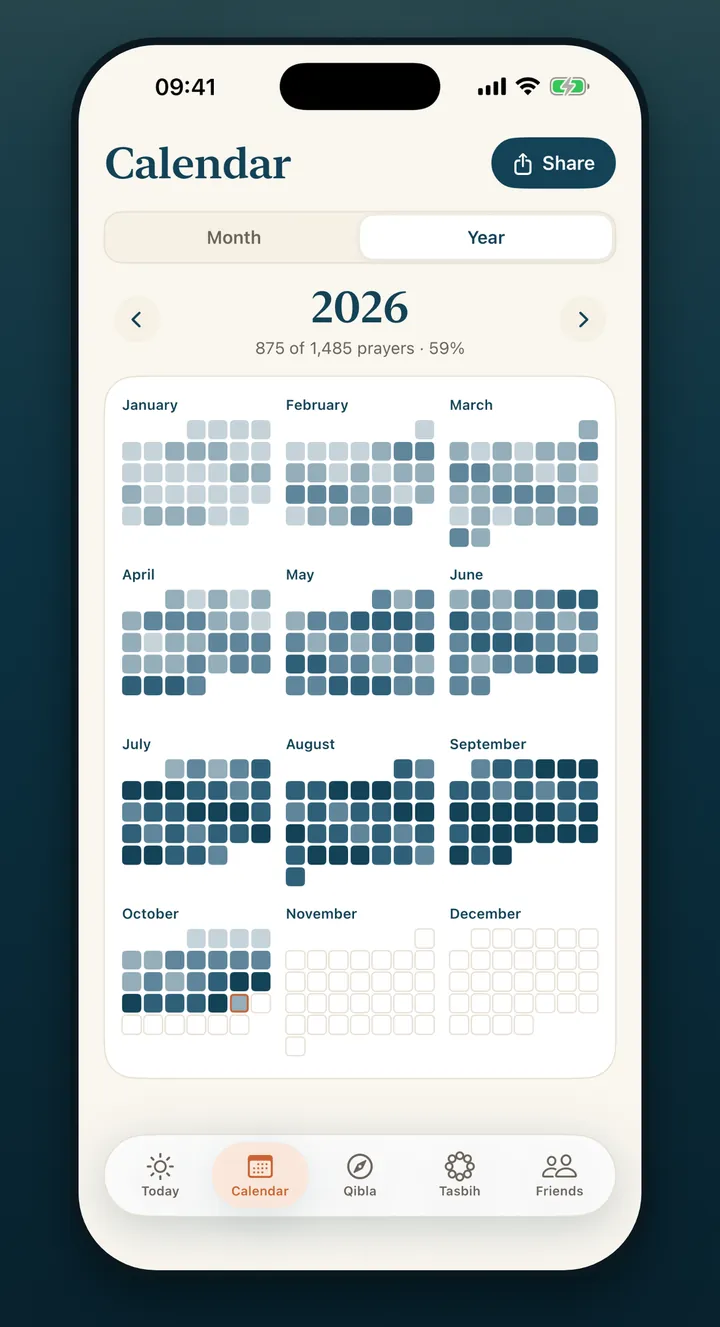
One square keeps one day in proportion
Without a calendar, a recent day can feel like the whole story. On a monthly view, it becomes one square among many. That visual proportion can make it easier to review the record as a pattern rather than as a verdict on one date.
Six colors, one consistent meaning
Praylendar maps zero through four completed prayers to deepening shades of one blue, and a day with all five turns gold. The meaning does not change between Today, the year view, widgets and exported cards. Once you learn the legend, the calendar is readable at any scale.
The month view answers “what is happening now?”
The monthly calendar is large enough to show each day clearly and close enough to support a regular review. Future dates are muted, the current day is easy to identify, and older entries retain their color even when editing is locked.
The year view answers “what changed over time?”
The annual view removes day numbers and keeps the colored shape of each month. It is designed for perspective rather than editing. Strong periods and quieter stretches can sit next to one another without either being hidden.
Share only the view you choose
A prayer calendar can remain fully private. When you do want to share, Praylendar creates dedicated week, month, 90-day and year cards instead of capturing the live app interface. The result has a centered calendar, an aligned legend and a clear Praylendar mark.
Consistency is personal. A color calendar is a record of entries, not a religious score and not a measure of another person's faith.
Use the calendar as a review tool
The simplest approach is to log daily and review occasionally. Let the daily checklist collect the information. Let the calendar summarize it. You do not need to study the pattern after every entry for it to remain useful.
Explore the Praylendar calendar
See the exact month, year and export features.